







Imagine a world where devices and systems not only connect and communicate but also learn and adapt to make your life easier. You’re probably wondering, how does this work? The answer lies in the integration of Artificial Intelligence and the Internet of Things, creating a powerful synergy known as the Artificial Intelligence of Things (AIoT).
AIoT combines the vast data collection capabilities of IoT devices with the analytical processing power of AI technology, enabling systems to gather information, interpret it, and act upon it autonomously. This convergence is reshaping how connected devices operate, making them smarter and more intuitive.
As you explore AIoT, you’ll discover its potential to revolutionize the way businesses operate, making them more efficient and competitive in today’s increasingly connected world.
Key Takeaways
- AIoT represents the convergence of AI and IoT, creating a powerful synergy.
- It enables devices and systems to gather information, interpret it, and act upon it autonomously.
- AIoT is reshaping how connected devices operate, making them smarter.
- Understanding AIoT is crucial for businesses looking to leverage this technology.
- AIoT has the potential to improve operational efficiency and reduce costs.
Understanding the Convergence of AI and IoT
As we dive into the world of connected devices, it’s essential to understand how artificial intelligence and the Internet of Things are converging. This convergence is creating a new technological ecosystem that’s greater than the sum of its parts.
Defining AIoT: The Fusion of Two Powerful Technologies
The term AIoT represents the strategic fusion of artificial intelligence capabilities with Internet of Things infrastructure. AI serves as the “brain” that processes and analyzes the vast amounts of data collected by IoT “sensors” or the “body” of the system, enabling intelligent decision-making. This fusion of technology and intelligence is transforming the way we interact with connected devices.
Why AIoT Matters in Today’s Connected World
In today’s connected world, AIoT matters because it addresses the fundamental challenge of extracting meaningful insights from the overwhelming volume of data generated by billions of connected devices. With connectivity on the rise, the integration of AI capabilities will be essential for managing this massive ecosystem effectively. By transforming passive data collection into actionable intelligence, AIoT drives business value and creates a smarter, more efficient world.
The Building Blocks of AIoT
You can think of AIoT as being composed of two main building blocks: the Internet of Things (IoT) and Artificial Intelligence (AI). These two technologies come together to create a system that is greater than the sum of its parts.
IoT: The Network of Connected Devices
The IoT is a vast network of connected ‘things’ – hardware devices that transmit critical operational, transactional, or sensor data. These devices range from simple sensors to complex machines, all capable of transmitting data across a network infrastructure. For instance, your toothbrush, a vending machine, or a wearable healthcare device like an insulin pump or heart monitor can be connected, enabling smarter lives and more informed business decisions.
- IoT creates a vast ecosystem of sensors and devices that continuously collect data.
- These devices form the sensory system that feeds information to the AI component.
Artificial Intelligence: The Brain Behind the Operation
AI is a deep learning technology that leverages the processing power of the cloud to simulate human thinking with machines. It’s typically used in natural language processing, speech recognition, and machine vision. The AI component acts as the cognitive center, processing collected data using advanced algorithms to identify patterns, make predictions, and generate insights, thereby providing intelligence.
- Machine learning, a subset of AI, enables these systems to improve over time.
- The integration of AI with IoT creates a system that can monitor, understand, and respond to its environment.
By combining IoT with AI, you’re not just collectingdata– you’re creating a sophisticated ecosystem that can operate autonomously and make intelligentdecisions. This is achieved through a continuous process that begins with IoT devices gathering vast amounts ofdatafrom their environment.
From Data Collection to Intelligent Decision-Making
The process starts with IoT devices collectingdata, which is then analyzed by AI algorithms to identify patterns, anomalies, and insights. These insights inform intelligentdecisionsabout system operations or necessary actions, creating a feedback loop where IoT provides the rawdatathat AI needs to function effectively.
The Complementary Relationship Between AI and IoT
The relationship between AI and IoT is complementary, with IoT providing thedataand AI providing the analytical capabilities that make thatdatavaluable. As noted by Maciej Kranz, “Without AI-powered analytics, IoT devices and thedatathey produce would have limited value.” This synergy creates a smart ecosystem that can predict maintenance needs, optimize resource allocation, and make autonomousdecisions.
Key Benefits of Implementing AIoT Solutions
AIoT adoption is transforming industries through smarter decision-making by combining raw data from IoT sensors with automated compute and actionable insights that are then executed on by the same system. This integration delivers multiple strategic benefits that directly impact your business performance and competitive positioning in the market.
Enhanced Operational Efficiency and Automation
By automating routine tasks and processes, AIoT solutions enable your human resources to focus on higher-value activities while machines handle repetitive operations, thus enhancing operational efficiency. This leads to improved productivity and reduced labor costs.
Improved Decision-Making Through Real-Time Analytics
You’ll achieve improved decisions-making capabilities through real-time analytics that process data as it’s generated, enabling immediate responses to changing conditions rather than reactive measures after problems occur. This capability is crucial for maintaining optimal business performance.
Cost Reduction and Resource Optimization
Cost reduction results from optimized resource utilization, predictive maintenance that prevents expensive equipment failures, and reduced downtime across your operations. The integration of IoT devices with AI capabilities allows for adaptive systems that can automatically adjust to changing conditions, maintaining optimal performance without constant human intervention.
| Benefit | Description | Impact |
|---|---|---|
| Enhanced Operational Efficiency | Automation of routine tasks | Improved productivity, reduced labor costs |
| Improved Decision-Making | Real-time analytics | Better response to changing conditions |
| Cost Reduction | Optimized resource utilization, predictive maintenance | Reduced downtime, lower operational costs |
As highlighted by industry experts, “The future of business lies in its ability to adapt and innovate through technology.” AIoT applications enable businesses to identify inefficiencies that would otherwise remain hidden, creating opportunities for process improvements and innovation.
AIoT Architecture: Edge, Fog, and Cloud Computing
AIoT’s effectiveness hinges on its architecture, which strategically utilizes edge, fog, and cloud computing to optimize data handling. This multi-faceted approach allows for the efficient processing of data across different layers, ensuring that AIoT applications can operate effectively.
Processing Data at the Edge vs. in the Cloud
Edge computing brings processing capabilities directly to or near IoT devices, reducing latency and enabling real-time decision-making. In contrast, cloud computing provides massive computational resources for complex AI algorithms and long-term data storage, albeit with potential latency.
The Role of Fog Computing in AIoT Deployments
Fog computing acts as an intermediary between edge and cloud, offering a balance of processing power and reduced latency. By positioning computing resources closer to data sources, fog computing optimizes AIoT deployments.
| Computing Paradigm | Location | Processing Power | Latency |
|---|---|---|---|
| Edge Computing | Near IoT Devices | Limited | Low |
| Fog Computing | Between Edge and Cloud | Moderate | Moderate |
| Cloud Computing | Centralized Data Centers | High | High |
The right architectural approach depends on specific requirements for latency, bandwidth utilization, processing power, and data security across different AIoT applications. By understanding the roles of edge, fog, and cloud computing, you can optimize your AIoT deployment.
Connectivity Options for AIoT Devices
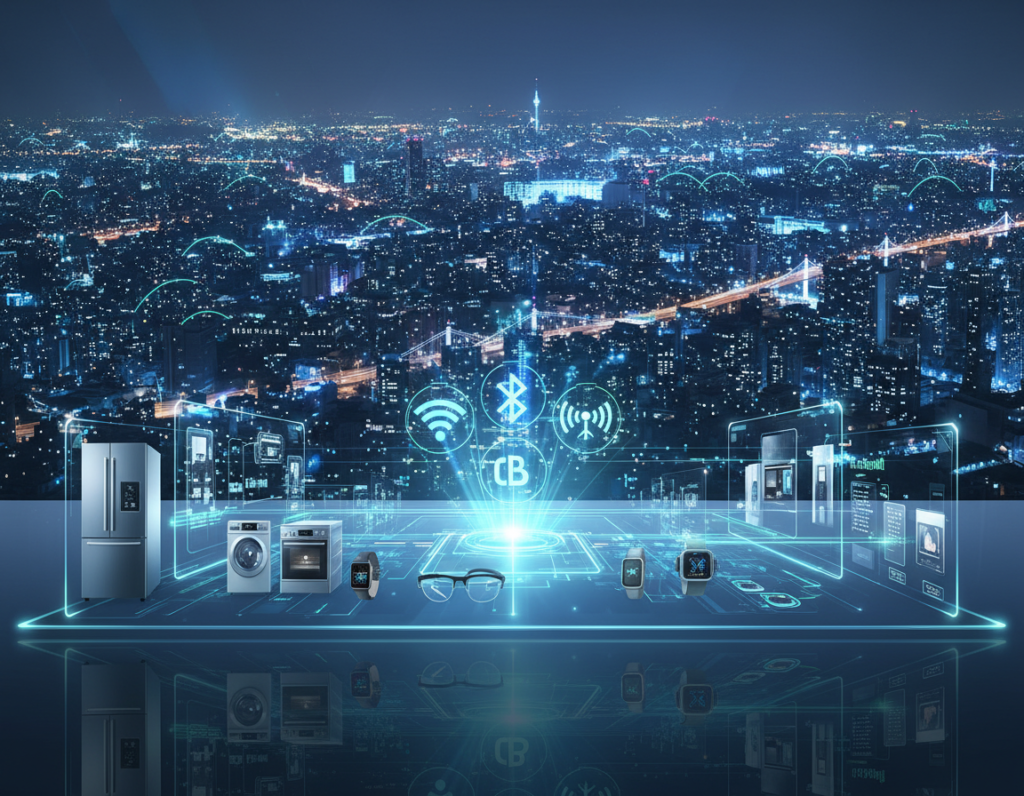
With the proliferation of AIoT devices, understanding the various connectivity options available is crucial. For any IoT device to deliver on its promise, it must have access to a secure, reliable connection. The choice of connectivity technology is critical and depends on the specific requirements of your AIoT application.
Short-Range Technologies: Bluetooth and WiFi
Short-range technologies like Bluetooth and WiFi offer high data rates and relatively simple implementation for applications where devices are concentrated in a limited area, such as smart homes or office environments. These technologies are ideal for scenarios where devices need to communicate with each other or with a central hub over short distances.
Long-Range Solutions: LPWAN and Cellular
For applications that require wider coverage, LPWAN (Low-Power Wide-Area Network) technologies and cellular connectivity provide extended coverage for widely distributed IoT devices. LPWAN is particularly useful for applications that need to transmit small amounts of data over long distances while minimizing power consumption. Cellular connectivity, on the other hand, offers the advantage of widespread coverage and high data throughput, making it suitable for applications that require mobility and high reliability.
Selecting the Right Connectivity for Your AIoT Application
When selecting the optimal connectivity solution for your specific AIoT application, you’ll need to consider factors such as battery life, data volume, transmission frequency, and geographic distribution. The right connectivity choice depends on your specific use case—whether you need real-time communication for critical applications or can tolerate delayed transmission for non-critical monitoring. Many sophisticated AIoT deployments utilize multiple connectivity technologies in a complementary fashion, creating redundancy and optimizing for different operational conditions.
AIoT Applications Across Industries
AIoT is revolutionizing the way industries operate, making them more efficient and intelligent. The integration of artificial intelligence with the Internet of Things is creating a new ecosystem where devices and systems can interact, analyze data, and make decisions autonomously.
The applications of AIoT are diverse and widespread, transforming various sectors in unique ways. Some of the key areas where AIoT is making a significant impact include:
- Smart cities, where AIoT integrates traffic management, public safety monitoring, and energy distribution.
- Industrial settings, where AIoT enables predictive maintenance, quality control automation, and supply chain visibility.
- Healthcare, where AIoT facilitates remote patient monitoring, predictive diagnostics, and operational efficiency.
- Retail environments, where AIoT creates personalized shopping experiences, manages inventory, and analyzes consumer behavior.
- Smart homes and buildings, where AIoT optimizes energy management, security systems, and occupant comfort.
Smart Cities: Creating Urban Intelligence
Smart cities leverage AIoT to integrate various urban systems, creating cohesive urban intelligence platforms that improve efficiency and quality of life. This includes managing traffic flow, public safety, waste management, and energy distribution.
Industrial AIoT: Transforming Manufacturing and Supply Chains
Industrial AIoT applications transform manufacturing environments through predictive maintenance, quality control automation, and supply chain visibility, driving significant improvements in productivity and reducing operational costs.
Healthcare: Remote Monitoring and Predictive Diagnostics
In healthcare, AIoT enables remote patient monitoring, predictive diagnostics, and medication adherence tracking, improving patient outcomes and healthcare economics.
Retail: Personalized Shopping Experiences
Retail environments utilize AIoT for personalized shopping experiences, inventory management, and consumer behavior analytics, bridging the gap between online and in-store experiences.
Smart Homes and Buildings: Comfort and Efficiency
Smart homes and buildings leverage AIoT for energy management, security systems, and occupant comfort optimization, responding to usage patterns and preferences.
Real-World Examples of AIoT in Action
The integration of AI and IoT is creating smarter systems that are changing our world. This fusion of technologies is being applied across various industries, leading to enhanced efficiency, automation, and decision-making.
Tesla’s Self-Driving Cars: A Network of Learning Vehicles
Tesla’s self-driving cars represent a sophisticated AIoT network. Each vehicle collects environmental data through multiple sensors, processes it with onboard AI, and shares learning across the entire fleet to improve collective intelligence and performance. This network of learning vehicles enables Tesla to predict the behavior of cars and pedestrians on the road in various circumstances.
Nest Smart Thermostat: Adaptive Temperature Control
The Nest Smart Thermostat uses IoT to allow temperature checking and controls from anywhere using smartphone integration. AI plays a significant role in understanding user temperature preferences and daily schedules, adapting accordingly for optimal comfort and energy savings.
iRobot Roomba: Intelligent Navigation and Cleaning
iRobot’s Roomba showcases intelligent navigation by combining sensor data with machine learning algorithms to map environments, identify obstacles, and optimize cleaning paths. This results in more efficient cleaning with each use, demonstrating how AIoT enables machines to understand context and make decisions.
WildTrack: Preserving Endangered Species
WildTrack’s footprint identification technique uses AIoT to identify species, individuals, age, and gender from unique footprints. This enables non-invasive monitoring of endangered species populations and movement patterns, aiding in their preservation through data-driven insights and continuous learning.
These examples highlight how AIoT creates systems that continuously improve through learning, adapt to changing conditions, and operate autonomously to achieve specific objectives. The common thread across these implementations is the combination of environmental sensing with intelligent processing that enables effective monitoring and decision-making.
| AIoT Application | Industry | Key Benefit |
|---|---|---|
| Tesla Self-Driving Cars | Automotive | Enhanced Safety through Collective Learning |
| Nest Smart Thermostat | Home Automation | Optimized Energy Efficiency |
| iRobot Roomba | Consumer Robotics | Intelligent Navigation and Cleaning |
| WildTrack | Wildlife Conservation | Non-Invasive Monitoring of Endangered Species |
Implementation Challenges of AIoT Systems
As you explore the potential of AIoT, you’ll encounter several implementation challenges that require careful consideration. The successful deployment of AIoT systems depends on addressing these challenges effectively.
Data Security and Privacy Concerns
One of the primary concerns is data security and privacy. AIoT systems collect vast amounts of potentially sensitive information, necessitating robust encryption and access controls. Compliance with evolving regulatory frameworks is also crucial to maintaining the trust of consumers and stakeholders.
Integration with Existing Infrastructure
Another significant challenge is integrating AIoT components with existing infrastructure. Organizations often need to connect new systems with legacy infrastructure that wasn’t designed for such connectivity, potentially requiring middleware solutions or system upgrades to ensure seamless integration.
Power Consumption and Device Longevity
Power consumption management is critical for remote or battery-operated AIoT devices. Efficient algorithms, optimized communication protocols, and sometimes energy harvesting technologies are necessary to ensure device longevity and minimize maintenance needs.
| Challenge | Description | Potential Solution |
|---|---|---|
| Data Security | Protecting sensitive information | Robust encryption, access controls |
| Infrastructure Integration | Connecting with legacy systems | Middleware solutions, system upgrades |
| Power Consumption | Managing device energy use | Efficient algorithms, energy harvesting |
By understanding these challenges and implementing appropriate solutions, organizations can successfully deploy AIoT systems and reap their benefits.

Machine Learning Models in AIoT Applications
In the realm of AIoT, machine learning models serve as the analytical foundation for data-driven decision-making. These models determine how systems interpret data and make decisions based on observed patterns.
Training AI for Specific Industry Contexts
Training AI for specific industry contexts requires specialized datasets that accurately represent the environment in which the system will operate. This ensures relevance and accuracy in its analysis and predictions. You’ll need to consider the difference between generic AI models and industry-specific implementations.
Avoiding AI “Hallucinations” and Ensuring Data Quality
The quality of training data directly impacts model performance, making data curation, cleaning, and validation critical steps in developing reliable AIoT systems. Avoiding AI “hallucinations” requires rigorous testing and continuous monitoring.
| Machine Learning Approach | Purpose in AIoT |
|---|---|
| Supervised Learning | Pattern recognition and prediction |
| Unsupervised Learning | Identifying hidden patterns and anomalies |
| Reinforcement Learning | Autonomous decision optimization |
The Growing AIoT Market: Statistics and Trends
As the number of IoT devices continues to skyrocket, the AIoT market is experiencing significant expansion across various industries. This growth is driven by the increasing adoption of IoT technology and the integration of AI capabilities, which together create a powerful ecosystem.
Current Market Size and Adoption Rates
The current market size of AIoT is substantial, with 15.9 billion IoT devices worldwide in 2023. The adoption rates vary across different industry verticals, with manufacturing, utilities, retail, transportation, and government sectors leading the way. These industries are leveraging AIoT to enhance operational efficiency, improve customer experiences, and create new revenue streams.
Projected Growth Across Industry Verticals
The AIoT market is projected to continue its rapid growth, with the number of IoT devices expected to reach 32.1 billion by 2030. Different industry verticals will experience varying growth patterns, driven by specific use cases and value propositions. For instance, manufacturing will focus on production optimization and predictive maintenance, while retail will emphasize customer experience and inventory management. As the market grows, we can expect to see increased investment in specialized AIoT applications and services.
Future Directions for Artificial Intelligence of Things
As AI and IoT continue to converge, we’re entering an exciting new phase in the world of technology. The future of Artificial Intelligence of Things (AIoT) is being shaped by various emerging technologies that are enhancing both the sensing capabilities of IoT devices and the analytical power of artificial intelligence systems.
Emerging Technologies Enhancing AIoT Capabilities
Several key technologies are driving the evolution of AIoT. Quantum computing, for instance, promises to revolutionize AIoT by enabling complex calculations that current systems cannot perform. Additionally, 5G and eventually 6G connectivity will dramatically increase bandwidth and reduce latency for AIoT applications. Neuromorphic computing architectures that mimic human brain functions will also create more energy-efficient AI processing, extending the capabilities of edge devices while reducing power consumption.
Preparing Your Business for the AIoT Revolution
To stay ahead, your business needs to develop a strategic roadmap that identifies high-value use cases, builds necessary technical capabilities, and addresses organizational change management. Future AIoT systems will increasingly operate with greater autonomy, making complex decisions without human intervention while maintaining appropriate oversight mechanisms. By preparing now, you can harness the future performance of AIoT to drive innovation and business success.
Conclusion
The AIoT convergence revolutionizes the world, creating intelligent systems. It enhances efficiency, decision-making, and innovation. As you move forward, identifying high-value use cases is key. AIoT transforms devices and machines, making “smart” the new normal, driving intelligence and innovation.
FAQ
What is the difference between AIoT and IoT?
How does AIoT improve operational efficiency?
What are the key connectivity options for AIoT devices?
What are some examples of AIoT applications in smart cities?
How does AIoT impact data security and privacy?
What are the benefits of using edge computing in AIoT?
How can businesses prepare for the AIoT revolution?

Other Articles

Artificial Intelligence Tickets: Explore the Future
AR, VR, and AI: The Future is Here