






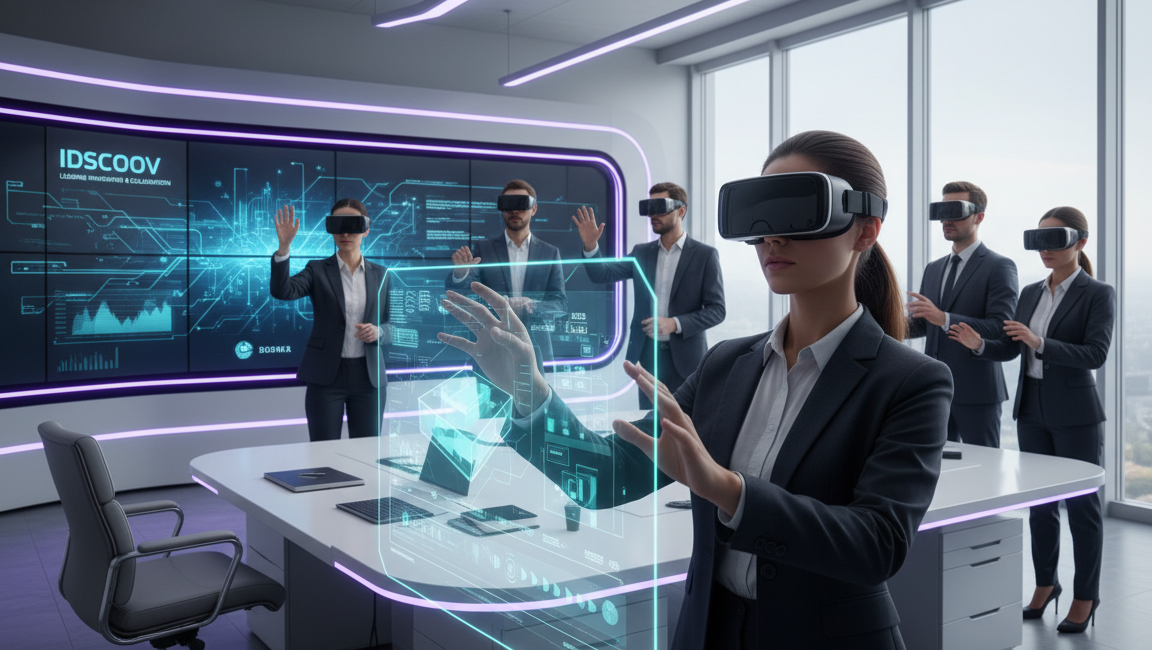
Are you ready to step into a world where the boundaries between the physical and digital blur? Imagine a reality where technologies like Augmented Reality and Virtual Reality, powered by Artificial Intelligence, revolutionize the way you interact with the world.
The convergence of AR, VR, and AI is not just a futuristic concept; it’s a present-day reality transforming industries from manufacturing to healthcare and education. These technologies are creating immersive experiences that enhance productivity, customer engagement, and training effectiveness.

As you explore this new reality, you’ll discover how these innovations are reshaping the world around you, making it more interactive and intelligent. The potential for growth and innovation is vast, and understanding these technologies is key to unlocking their full potential.
Key Takeaways
- The convergence of AR, VR, and AI is revolutionizing industries.
- These technologies enhance productivity and customer engagement.
- AR, VR, and AI create immersive experiences.
- The synergy between these technologies is transforming the world.
- Understanding these technologies is crucial for businesses.
Understanding the Convergence of AR, VR, and AI Technologies
As you explore the future of technology, you’ll discover that AR, VR, and AI are converging in exciting ways. This convergence is not just a coincidence; it’s a result of the complementary nature of these technologies. To understand this synergy, let’s first define what each of these technologies brings to the table.
Defining the Technology Trio
AR (Augmented Reality) overlays digital information onto the real world, enhancing your surroundings with virtual details. VR (Virtual Reality), on the other hand, creates entirely virtual environments that simulate real-world experiences. AI (Artificial Intelligence) serves as the backbone for both, enabling systems to learn, adapt, and interact with users more naturally.
How These Technologies Complement Each Other
The integration of AR, VR, and AI creates powerful experiences that revolutionize various industries. Through AI-powered object recognition, AR devices can identify real-world objects, while algorithms like SLAM build a 3D map of your surroundings. This allows for more realistic interactions between the physical and digital worlds.
- AI enhances AR and VR by providing the intelligence needed to interpret real-world data and create responsive virtual environments.
- Machine learning algorithms enable AR systems to recognize objects and gestures, facilitating natural interactions.
- VR experiences become more immersive and personalized when powered by AI, adapting to user behavior.
By understanding how AR, VR, and AI complement each other, businesses can develop more sophisticated applications tailored to their industry needs. This convergence is set to transform the way we interact with technology, making it more intuitive and immersive.
The Relationship Between AR, VR, and AI
The synergy between AR, VR, and AI is creating immersive experiences like never before. As these technologies converge, they form a powerful ecosystem that is transforming the way we interact with the world.
AI as the Brain Behind Immersive Experiences
AI serves as the technology that enables AR and VR systems to understand and interpret the environment. For instance, Google Lens uses computer vision technology to analyze images, providing relevant information about objects and landmarks. This capability is crucial for creating convincing AR experiences that interact naturally with physical surroundings.
By leveraging AI, AR and VR tools can recognize and track objects in real-time, allowing for precise placement of virtual objects. This integration enhances the overall user experience, making interactions more intuitive and immersive.
The Technical Foundation of Modern AR and VR
Modern AR and VR systems rely on sophisticated hardware and software components. The technical foundation includes sensors, cameras, displays, and processing units that work together to create an immersive environment. A comparison of the key components is shown in the table below:
| Component | AR Systems | VR Systems |
|---|---|---|
| Sensors and Cameras | Used for recognition and tracking of objects | Used for motion tracking and environment understanding |
| Displays | See-through displays for overlaying virtual objects | High-resolution displays for immersive reality |
| Processing Units | Handles recognition and rendering of virtual objects | Manages complex graphics processing for experiences |

The technical foundation of these technologies continues to evolve, driving new possibilities for immersive experiences. As improvements in processing power, display technology, and sensor capabilities emerge, we can expect even more sophisticated AR and VR applications.
How AI Powers AR and VR Experiences
AI is the backbone of modern AR and VR, enabling more intuitive interactions. By integrating AI into these technologies, you can enjoy a more immersive and interactive experience. AI enhances AR and VR by providing advanced capabilities such as object recognition, environment mapping, natural language processing, and gesture recognition.
Object Recognition and Environment Mapping
Object recognition and environment mapping are crucial for creating realistic AR and VR experiences. AI algorithms can identify objects within a scene and map the environment, allowing for more accurate and interactive experiences. This technology enables AR and VR systems to understand and respond to the user’s surroundings, creating a more immersive experience. Accurate object recognition is key to seamless interactions within virtual environments.
As AI continues to improve, the accuracy of object recognition and environment mapping increases, enabling more complex and nuanced interactions. This advancement is critical for applications that require precise understanding and replication of real-world environments.
Natural Language Processing and Gesture Recognition
Natural language processing (NLP) and gesture recognition are transforming the way you interact with AR and VR. NLP enables voice-controlled interactions, allowing for hands-free operation and more intuitive user experiences. “The future of AR and VR lies in natural, intuitive interactions.” Gesture recognition systems track and interpret hand and body movements, translating them into commands within virtual environments.
- NLP and gesture recognition reduce the learning curve for AR and VR applications by allowing users to interact using familiar communication methods.
- The combination of voice and gesture recognition creates multimodal interaction possibilities that enhance the immersive quality of AR and VR experiences.
As these recognition technologies improve, they enable more complex and nuanced interactions with virtual content, expanding the potential applications for business and consumer use. By leveraging AI-driven NLP and gesture recognition, you can enjoy a more natural and engaging experience in AR and VR.
Overcoming Technical Challenges in AR, VR, and AI Integration
One of the significant barriers to the widespread adoption of AR, VR, and AI is overcoming the technical challenges associated with their integration. As these technologies continue to advance, addressing issues such as latency and rendering becomes crucial for creating immersive experiences.
Addressing Latency Issues
Latency is a critical challenge in AR and VR systems, as it can cause discomfort and disrupt the user experience. To mitigate this, developers are focusing on optimizing rendering processes and improving hardware capabilities. By reducing the time it takes for systems to respond to user interactions, these technologies can provide a more seamless experience.
Several strategies are being employed to address latency, including the use of more powerful processors and the development of more efficient algorithms. Additionally, techniques such as predictive modeling can help anticipate user actions, further reducing latency.
| Technique | Description | Impact on Latency |
|---|---|---|
| Predictive Modeling | Anticipates user actions to pre-render content | High Reduction |
| Optimized Rendering | Improves rendering efficiency | Moderate Reduction |
| Hardware Upgrades | Enhances processing power | Significant Reduction |
Foveated Rendering and Neuromorphic Cameras
Foveated rendering is an innovative technique that mimics human vision by rendering only the portion of the virtual environment that the user is directly looking at in high detail. This approach significantly reduces processing requirements and latency by allocating computational resources more efficiently. Neuromorphic cameras, inspired by the human visual system, can track eye movements with exceptional speed and accuracy, enabling effective foveated rendering.

By leveraging these technologies, developers can create more complex and detailed virtual environments while reducing hardware requirements. This makes immersive technologies more accessible and enhances the overall user experience. As these technologies mature, they will enable more sophisticated AR and VR experiences, revolutionizing the way we interact with digital information in the real world.
Business Applications of AR, VR, and AI
AR, VR, and AI are not just technologies; they’re catalysts for business innovation. These cutting-edge technologies are being adopted across various industries to enhance user experience, improve operational efficiency, and drive development.
Manufacturing and Industrial Applications
In manufacturing, AR, VR, and AI are revolutionizing production processes. For instance, AI-powered predictive maintenance can forecast equipment failures, reducing downtime. VR is used for training employees in complex assembly procedures, while AR enhances quality control by overlaying digital information onto physical products.

Retail and Customer Experience
The retail sector is leveraging AR, VR, and AI to create immersive experiences for customers. Virtual try-on solutions using AR allow customers to see how products look without physically trying them on. AI-driven chatbots provide personalized customer service, enhancing the overall shopping experience.

Healthcare and Medical Training
In healthcare, VR and AR are being used for medical training and patient treatment. VR simulations allow surgeons to practice complex procedures, while AR is used to visualize patient data during surgery. AI algorithms help in diagnosing diseases more accurately and suggesting personalized treatment plans.

Education and Corporate Training
Educational institutions and corporate training departments are utilizing AR, VR, and AI to create engaging learning environments. AI personalizes the learning experience by adapting content difficulty based on individual performance. VR simulations provide realistic training scenarios, enhancing skill acquisition.

As these technologies continue to evolve, their applications across industries will expand, driving innovation and efficiency. Businesses that adopt AR, VR, and AI will be better positioned to meet the changing demands of their customers and stay ahead of the competition.
AI-Generated Content vs. Traditional Content Creation in VR and AR
The integration of AI in VR and AR content creation is revolutionizing the way we experience virtual worlds. As AI-generated content becomes more prevalent, it’s essential to understand its advantages and limitations compared to traditional content creation methods.
Advantages of AI-Generated Content
AI-generated content offers several benefits, including increased efficiency and scalability. AI algorithms can produce high-quality content at a faster rate than human creators, making it ideal for applications where speed and volume are crucial. For instance, AI can generate procedural content, such as 3D models and environments, that can be used to create diverse and dynamic experiences.
Benefits of AI-Generated Content
| Benefit | Description |
|---|---|
| Efficiency | AI can produce content at a significantly faster rate than humans. |
| Scalability | AI-generated content can be easily scaled to meet the demands of large-scale VR and AR applications. |
| Personalization | AI can create personalized content tailored to individual user preferences. |
Limitations and the Need for Human Creativity
Despite the advantages of AI-generated content, there are limitations to its use. AI algorithms lack the creativity and intuition of human creators, resulting in content that may not be as emotionally resonant or nuanced. Moreover, AI-generated content raises ethical concerns related to ownership and copyright.
Limitations of AI-Generated Content
- Lack of human creativity and intuition
- Potential for low-quality or unengaging content
- Ethical concerns regarding ownership and copyright
In conclusion, while AI-generated content offers several benefits, it is not a replacement for human creativity. The most effective approach is to combine AI-generated elements with human creative direction and curation, ensuring high-quality and engaging user experiences.
Future Trends in AR, VR, and AI Development
As we look to the future, the convergence of AR, VR, and AI technologies is poised to revolutionize numerous industries. The potential for new applications and experiences is vast, and businesses are expected to leverage these technologies for competitive differentiation.
Emerging Technologies and Innovations
The development of AR, VR, and AI is driven by emerging technologies and innovations. For instance, AR environments ingest data from the real world, using sensors such as LIDAR, video, images, and audio. This enables the creation of more immersive and interactive experiences. As hardware costs decrease and development tools become more accessible, we can expect to see new and innovative uses of these technologies.
Predictions for Business Adoption
Business adoption of AR, VR, and AI technologies is expected to accelerate as industries like healthcare, manufacturing, and retail lead the way. These industries are likely to adopt these technologies due to the clear ROI in training, operational efficiency, and customer experience. The integration of these technologies into existing business processes will become more seamless, reducing implementation barriers.
| Industry | Potential Applications | Benefits |
|---|---|---|
| Healthcare | Medical training, patient education | Improved patient outcomes, reduced costs |
| Manufacturing | Worker training, quality control | Increased efficiency, reduced errors |
| Retail | Customer experience, product demonstrations | Enhanced customer engagement, increased sales |
As standards and best practices emerge, the risks associated with early adoption will decrease, encouraging more conservative organizations to implement these technologies. You can expect to see significant advancements in various sectors as AR, VR, and AI continue to evolve.
Conclusion: Preparing Your Business for an Immersive Future
The future of business is being shaped by the integration of AR, VR, and AI, and it’s vital that your organization is prepared. Advances in these technologies will drive the development of more engaging, interactive, and personalized experiences, particularly in eLearning. AI’s capability to provide real-time feedback and tailor learning experiences will ensure that instructional material meets the needs of learners.
To capitalize on the potential of these technologies, your business needs to be proactive. Preparing for an immersive future requires strategic planning, investment in skills development, and a willingness to experiment with new technologies. Organizations that start exploring AR, VR, and AI applications now will be better positioned to capitalize on their potential as they mature.
By building internal expertise and partnerships with technology providers, you can ensure successful implementation and ongoing innovation. The convergence of AR, VR, and AI is not just a technological shift; it represents a fundamental change in how businesses operate, engage with customers, and develop their workforce in a rapidly evolving world.
FAQ
What are the primary technologies driving immersive experiences?
How does AI enhance AR and VR experiences?
What are some business applications of AR, VR, and AI?
What are the technical challenges in integrating AR, VR, and AI?
How can AI-generated content benefit VR and AR experiences?
What are the limitations of AI-generated content in VR and AR?
What are some emerging trends in AR, VR, and AI development?

Other Articles

What is the Artificial Intelligence of Things (AIoT)?
Latest News on Virtual Reality Technology