








Imagine a world where your smartphone or tablet can bring textbooks to life. This is the promise of Augmented Reality, or AR. Unlike Virtual Reality, which creates a completely digital environment, AR adds digital information on top of what you see around you.
You might have experienced this exciting technology through popular games. Now, these same technologies are revolutionizing education. They create immersive experiences that make complex subjects easier to grasp.
This guide will show you how AR transforms the way we acquire knowledge. You will discover its unique advantages for modern learning environments. We will explore practical applications and how to integrate these powerful tools effectively.
Key Takeaways
- Augmented Reality (AR) overlays digital content onto your real-world view.
- AR differs from Virtual Reality (VR) by enhancing your surroundings instead of replacing them.
- You can access AR experiences using common devices like smartphones and tablets.
- This technology creates highly interactive and engaging educational experiences.
- AR has the potential to improve understanding and retention of complex information.
- Major institutions are increasingly adopting AR to enhance their teaching methods.
Overview of AR in Online Education
Today’s educational landscape is being reshaped by augmented reality technologies that overlay digital content onto physical environments. This approach fundamentally differs from traditional methods by creating hybrid experiences.
You can access these immersive tools using common devices like smartphones and tablets. The technology bridges theory and practice in powerful ways.
Defining Augmented Reality in Modern Learning
Augmented reality comes in two main forms that serve different educational purposes. Marker-based systems use image recognition through triggers like QR codes.
When you point your device at these markers, educational content appears anchored to them. Location-based systems use GPS and sensors to create geographically-tied experiences.
This allows for field-based education where information appears contextually relevant. Both methods transform static textbook data into interactive visualizations.
Evolving Trends in AR Implementation
Educators are increasingly adopting these tools beyond traditional classroom settings. Current trends show expansion into fully digital and hybrid environments.
Improved image recognition and faster processing make the technology more accessible. You can now find applications ranging from simple overlays to complex simulations.
These tools respond to your interactions in real-time, creating personalized pathways. The evolution reflects broader technological advances benefiting modern education.
Benefits of AR Online Learning for You
Discover how interactive digital overlays can revolutionize your approach to acquiring new competencies. This technology transforms you from a passive observer into an active participant in your educational journey.
You gain practical abilities more efficiently through immersive scenarios. These environments let you practice procedures repeatedly without real-world risks.
| Traditional Methods | Augmented Reality Approach | Your Advantage |
|---|---|---|
| Passive reading/viewing | Active manipulation of content | Higher engagement and retention |
| Abstract concept explanations | Visual, contextual demonstrations | Deeper understanding |
| Limited practice opportunities | Risk-free repetitive scenarios | Faster skill development |
| Fixed learning pace | Self-directed exploration | Personalized growth path |
The technology empowers you to explore content at your own pace. This independence fosters curiosity-driven pathways that align with your individual comprehension levels.
Complex subjects become more accessible through visual, step-by-step sequences. You can observe processes from multiple angles until achieving mastery.
This method creates stronger neural connections by engaging multiple senses simultaneously. The result is deeper encoding and longer-lasting memory formation.
Your professional development accelerates as you bridge theory with practical application. Organizations report improved training outcomes and reduced time-to-competency.
Getting Started with AR Online Learning
Successfully launching an augmented reality program begins with assessing your infrastructure and selecting the right software. This practical approach ensures smooth implementation from day one.
Assessing Your Technical Infrastructure
You can start with minimal investment since most augmented reality solutions work on standard smartphones and tablets. These devices likely already exist within your organization.
Evaluate device compatibility, internet bandwidth, and processing capabilities. This prevents frustrating technical barriers during implementation.
Take inventory of existing devices in your classroom or organization. Check specifications against platform requirements to identify any gaps.
Selecting Effective AR Tools
Match your educational objectives with platform capabilities. Solutions like Zappar and Vuforia offer content creation tools for educators.
Consider ease of content creation and library resources. Analytics and collaboration features also matter for effective management.
Prioritize products with strong support communities and regular updates. This keeps your implementation current with best practices.
Gather information through pilot testing with small groups. This reveals user experience issues before full deployment.
Integrating ar online learning in Your Curriculum
Transforming your curriculum with augmented reality tools requires mapping technology capabilities to specific instructional needs. This strategic approach ensures digital enhancements serve clear educational purposes rather than becoming technological distractions.
Step-by-Step Integration Process
Begin by identifying objectives where visualization adds unique value. Look for topics involving complex three-dimensional concepts or procedural skills.
Map your existing curriculum to pinpoint these opportunities. Focus on areas where traditional methods struggle to convey spatial relationships effectively.
Collaborate with instructional designers to develop coherent educational journeys. Blend augmented experiences seamlessly with conventional materials.
Aligning AR Features with Learning Goals
Match specific augmented capabilities with measurable outcomes you want to achieve. Consider 3D model manipulation for anatomy lessons or location-based information for historical studies.
Follow a phased implementation strategy starting with one module. Gather feedback and refine your approach before expanding.
Create detailed lesson plans specifying when and how to introduce augmented content. Connect these experiences directly to assessment methods for effective management.
Provide professional development opportunities for educators. Build their confidence in facilitating these immersive experiences to maximize educational impact.
Enhancing Engagement Through Interactive AR Experiences
When learners become explorers rather than spectators, engagement levels soar and retention improves dramatically. Interactive augmented environments transform passive observation into active discovery.
These experiences empower individuals to manipulate digital content directly. This hands-on approach builds confidence and motivation.
Engagement Strategies for Immersive Learning
Design scenarios that require decision-making and problem-solving. Gamification elements like achievements and challenges maintain interest over time.
Branching pathways create personalized journeys. Each choice influences subsequent content and difficulty levels.
Embed frequent practice opportunities within the experience. Repetition in varied contexts builds muscle memory and deep understanding.
Provide immediate feedback on progress. Learners see exactly what they’ve mastered and where they need more practice.
Collaborative features extend engagement beyond individual sessions. Multiple participants can interact with the same augmented environment simultaneously.
Well-designed interactive content reduces cognitive fatigue. Attention spans typically increase compared to traditional methods.
Practical Applications of AR in Different Industries
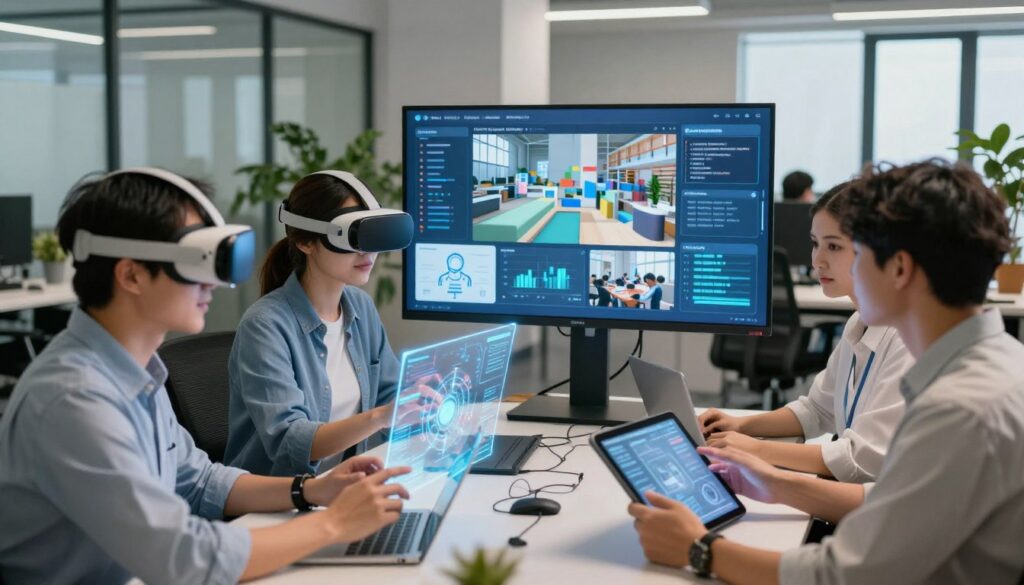
Across multiple sectors, augmented reality creates powerful training simulations that bridge theoretical knowledge with hands-on application. This technology delivers immersive experiences where you can develop critical abilities in realistic environments.
Transforming Healthcare and Manufacturing Training
Medical professionals use augmented tools to examine anatomical structures in three dimensions. You can practice complex procedures on virtual patients without any risk.
This approach builds confidence before working with real cases. Manufacturing settings benefit from step-by-step visual guides overlaid directly on equipment.
You learn machinery operation and maintenance through interactive demonstrations. This method significantly reduces training time while improving accuracy.
Innovative Uses in Classroom and Corporate Settings
Educational institutions bring abstract concepts to life through immersive visualizations. Your classroom becomes an interactive space for exploring everything from molecular structures to historical events.
Corporate programs use these tools for efficient employee onboarding. You receive just-in-time guidance for job-specific skills that traditionally required extensive shadowing.
Retail and hospitality sectors create realistic scenarios for customer service training. These simulations help you build practical communication abilities across diverse situations.
Measuring the Impact of AR on Learning Outcomes
Quantifying educational progress becomes essential when implementing new technologies. You need clear baseline metrics before starting to accurately measure impact.
Collect completion rates, assessment scores, and satisfaction data using traditional methods. This creates your comparison foundation.
Tracking outcomes requires both numbers and personal feedback. Quantitative information includes test scores and error rates.
Qualitative data comes from surveys and observational assessments. Together they provide complete results.
| Measurement Type | Key Metrics | Your Insights Gained |
|---|---|---|
| Quantitative Analysis | Test scores, completion times, certification rates | Objective performance improvement evidence |
| Qualitative Assessment | Survey responses, interview feedback, confidence levels | Learner experience and engagement depth |
| Long-term Tracking | Job performance, quality metrics, retention rates | Real-world skill application effectiveness |
Pre- and post-assessments should measure practical skills application beyond knowledge recall. This captures the full educational impact.
Implementations consistently show increased information retention. Learners demonstrate better recall months later.
Your strategy should include platform-specific engagement metrics. Track session duration and interaction patterns.
Effective management of analytics involves regular data review. Identify which content produces the best results for continuous optimization.
Overcoming Challenges in AR Online Learning Deployment
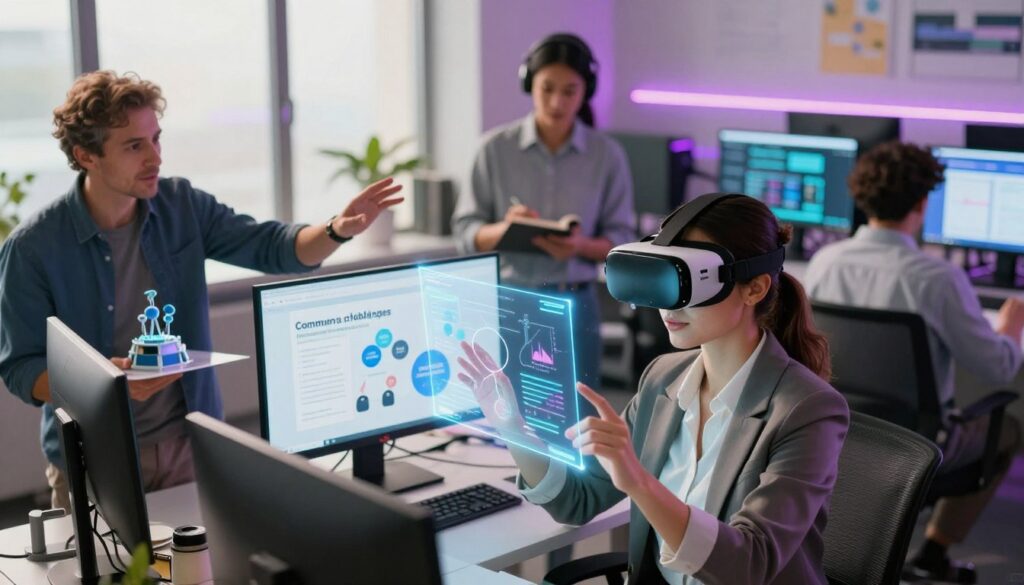
Implementing new educational technologies inevitably presents deployment hurdles that require strategic planning. You will face both technical and practical obstacles that demand thoughtful solutions.
Addressing Technological Limitations
Device fragmentation creates compatibility issues across different smartphones and tablets. You need to establish minimum standards or develop cross-platform approaches.
Connectivity challenges require offline capabilities for areas with limited internet access. Compressed content formats help manage bandwidth demands effectively.
The technology learning curve affects both educators and participants. Allow sufficient time for comfort with interfaces before expecting full efficiency.
Balancing Budget and Scalability
Financial constraints force careful investment decisions. You must balance content creation costs against long-term growth objectives.
Scalability concerns emerge when expanding successful pilots. Consider these key factors:
- Content library expansion requirements
- Technical support infrastructure needs
- Quality maintenance during participant increases
Effective management involves phased deployment strategies. Start with departments where the technology provides maximum value.
Cross-functional teams should share information and develop practical approaches. This collaborative troubleshooting ensures sustainable implementation.
Case Studies: Success Stories in AR Online Learning
Measurable outcomes from diverse industries showcase the effectiveness of augmented educational approaches. These documented achievements provide compelling evidence for organizations considering similar implementations.
Real-World Examples from Industry Leaders
Healthcare institutions report remarkable success with anatomical training. Medical students using interactive overlays achieved 30-40% better diagnostic accuracy than traditional methods.
Manufacturing industry leaders document impressive results. AR-guided assembly training reduced errors by over 50% while cutting training time significantly.
Educational institutions worldwide transform their classroom environments. STEM concepts come alive through immersive visualizations, boosting engagement and test scores.
Corporate programs using solutions like Zappar and Vuforia report enhanced employee confidence. Participants prefer these interactive experiences over conventional training sessions.
Aviation maintenance training demonstrates global impact. Technicians follow complex procedures with visual guidance, improving safety compliance across the world.
Retail organizations achieve success with product knowledge training. Sales associates learn through interactive 3D models, leading to better customer service ratings.
These examples prove that effective implementation requires thoughtful management. The right products combined with strategic integration deliver measurable improvements.
Preparing for the Future with AR Online Learning Innovations
Forward-thinking institutions are already preparing for the next wave of technological advancements in interactive education. The landscape continues to evolve rapidly, offering new opportunities for immersive instruction.
Anticipating Emerging Technologies
You should expect artificial intelligence to merge with augmented reality. These systems will analyze your interactions and adjust content automatically. The pacing and difficulty will match your individual progression.
Spatial computing will become more sophisticated. You’ll interact through natural gestures and voice commands. Touchscreen interfaces will no longer be your only option.
5G networks and edge computing will eliminate latency issues. You can access complex simulations instantly without downloads. High-fidelity experiences will be available anywhere.
Collaborative environments will see significant growth. Multiple participants can interact in shared augmented spaces. This revolutionizes team training and group projects.
Future solutions will integrate seamlessly with existing systems. AR components become natural extensions rather than standalone applications. Educators benefit from sophisticated content creation products.
These products require minimal technical skills. Subject matter experts can build immersive experiences independently. Strategic planning now ensures smooth adoption later.
Establish flexible management structures and development programs. This positions you for continued growth in an enhanced educational landscape.
Conclusion
Your understanding of interactive educational technologies now positions you for meaningful implementation. The journey through this guide has equipped you with comprehensive insights into augmented approaches.
You can create engaging experiences that build practical skills through hands-on practice. This method transforms abstract concepts into tangible understanding for learners.
Your success depends on maintaining focus on educational objectives while leveraging technological advantages. The right approach enhances knowledge retention and competency development.
Moving forward, you possess the foundation to create transformative educational experiences. Embrace these tools while keeping fundamental teaching principles at the core of your strategy.
FAQ
What is augmented reality in education?
How can AR help me manage my time better as a learner?
What do I need to get started with AR learning solutions?
Can AR be used for professional skills development?
How do educators measure the impact of AR on learning outcomes?
What are the main challenges when deploying AR, and how can they be overcome?

Other Articles

How to Create an AI Algorithm: A Beginner’s Guide
AI Applications for Enhanced Cybersecurity